


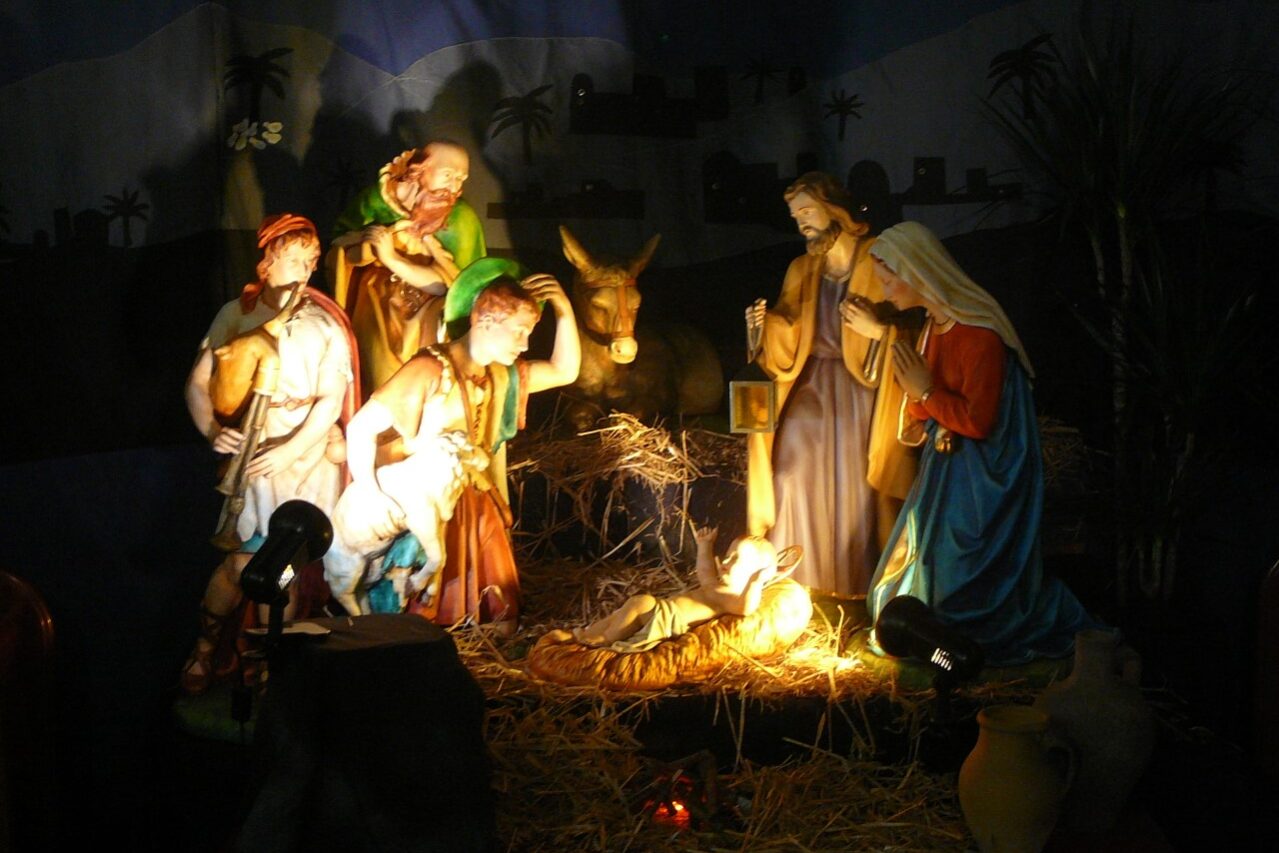
The reading from the Prologue of John’s Gospel occurs on the second Sunday after Christmas, so we might focus today on the extracts from the Gospel of Luke which are given for the Masses during the Night and at Dawn: these describe the birth of Jesus in Bethlehem and the visit of the shepherds.
Joseph and Mary have to travel to Bethlehem to be registered with the Roman authorities. Bethlehem is the city associated with King David, and the Messiah was expected to be of David’s line. It was therefore not fitting that the heir to the promises to David should be lodged in what we would consider a motel, a temporary shelter for travellers: hence the child was born and laid in a stone feeding trough used by animals. The swaddling clothes in which the child is wrapped remind the reader of David’s son Solomon and, along with the manger, look ahead to the burial of Jesus after his crucifixion.
The birth of Jesus is the fulfilment of Mary’s positive decision to accept her place in God’s plan. Luke will later show her as the model disciple, the one who listens to God’s word, meditates upon it and puts it into practice.
The shepherds anticipate the theme in the Gospel of God’s concern for those who are marginalised and excluded from the normal religious and social life of the community. Their nomadic lifestyle meant that they could not fulfil the expected ritual obligations and, like all groups on the periphery, they were regarded with suspicion by the town dwellers and blamed when anything went missing. But it is to these characters that the divine message of the birth of the Messiah is given. They then become bearers of God’s revelation to others, including Mary, “who treasured all these things and pondered them in her heart”
Previous Sunday Messages


REFLECT
There was an outcry some years ago when the Christmas Day special edition of Downton Abbey ended with the tragic death of Matthew Crawley in a traffic accident. Admittedly, this does seem to be a somewhat insensitive ending to the Christmas episode of a popular drama. But perhaps we might reflect today on the fact that the Gospel stories surrounding the birth of Jesus are overtures to the main narrative: the evangelists, Luke and Matthew, are stating themes which they will develop in their accounts of the life and ministry of Jesus.
The greatest danger to understanding the Infancy Narratives is sentimentality. The Victorian carols and hymns which are so popular are very pleasant. But the earlier medieval hymns for the Christmas period all have the shadow of the cross over them. “The Holly and the Ivy” is a good example of this writing.
It is all very well to concentrate on the child Jesus, but Luke is hinting that we need to keep in mind what this birth will entail. The shepherds’ reaction to their experience is to “praise and glorify God”: we might do the same, not just on account of the birth of Jesus, but for all God has done for us in and through Jesus.
learn
- The Infancy Narratives are composed of the first two chapters of the Gospels of Matthew and Luke.
- They are, more or less, completely different and we should read them on their own terms: they are theological documents rather than history or biography.
- In these chapters, the evangelists present their belief about the person of Jesus.
do
Set out your crib figures or visit the scene in your church: reflect on the fact that God was prepared to come into our world as a child for your sake.