



Fr Marco Lazzaron
oday, as friends of Jesus, we may also feel active like Martha, contemplative and (sometimes) desolate like Mary, fragile and in the tomb like Lazarus. Yet when we place ourselves before God, we often fear that we should reach a certain prior perfection in order to be His friends. It might even seem excessive to speak to Jesus with the boldness of Martha and Mary, as if we were unsuitable for this relationship with God.
The mystics understood the profound depth of the relationship God asks of us. It is an invitation to change our way of thinking, to recognize that friendship with Jesus does not arise from perfection, and does not have a meritorious character. In this Gospel passage we discover Jesus both as a true friend and as one who receives friendship. It is a real relationship, so much so that Jesus even allows himself to be reproached by the honesty and the distress of Mary: “If you had been here, my brother would not have died!”
How does Jesus express his friendship? In his mission. It seems that Jesus deliberately arrived late in order to reveal his work: “Lazarus has died, and for your sake I am glad that I was not there, so that you may believe.” Jesus manifests the glory of God in a fully human and relational life and shows us how embracing his style and welcoming the Holy Spirit makes our lives and our relationships beautiful and fruitful. However, the roles we sometimes proudly assume can ruin friendships, create distances and suspicions, and sometimes generate inhuman attitudes. Jesus, instead, is fully God and also fully man; thus he teaches us true humanity and true friendship.
So much so that the disciples—who often did not understand all of Jesus’ words and the reasons for his actions, yet tried to practice a trusting obedience—were surprised that Jesus risked his life just to go and visit Lazarus. The disciples, like the Jews, had to recognize Jesus’ love for his friend and witness his expressions of grief. Indeed, he was deeply troubled; Jesus enters into radical sorrow, the kind that does not remain in the soul but marks the body. Jesus shares what the friend feels, allows himself to be touched by the friend’s joys and struggles, and at the same time remains Teacher, guide, a presence that gives direction.
Even with his friend Martha, Jesus leads her to one of the greatest professions of faith in the Gospel: “Yes, Lord, I believe that you are the Christ, the Son of God, the one who is coming into the world”. The friendship that Jesus reveals is nourished by presence and relationship, in the hic et nunc (here and now). A friend is someone who can remain within difference and can feel another’s pain, rejoice in another’s joy, and love with a selfless love.
Don Lorenzo Milani wrote: “If I said that I believe in God I would be saying too little, because I love Him; and you understand that loving someone is something more than believing in his existence”.
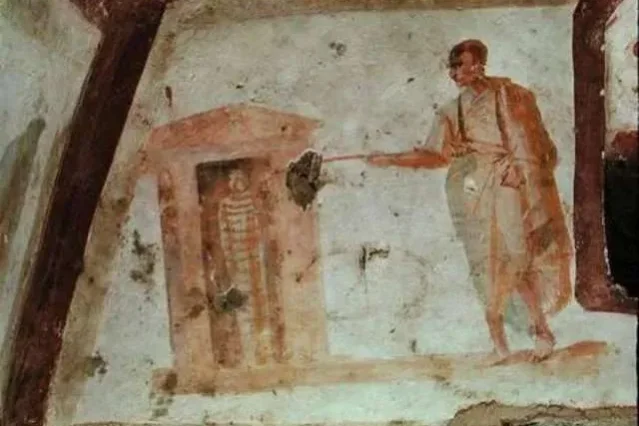
“Unbind him and let him go”. This is the paraphrase of God’s love that we must learn: a love that liberates. Today we can pray saying: “Open my tomb, Lord; call me to life with you. Come and make me your friend”.
PRAYER
Lord Jesus, true man like us, You wept for your friend Lazarus, and as the eternal God you called him back from the tomb. Today extend your mercy over all humanity, and through the holy mysteries lead us from the darkness of death to the light of life. May our hearts open to your presence, may our faith be renewed in hope, and may our lives be a sign of your victory. (Prayer inspired by the Roman Missal, Preface of the Fifth Sunday of Lent.)