



Fr Marco Lazzaron
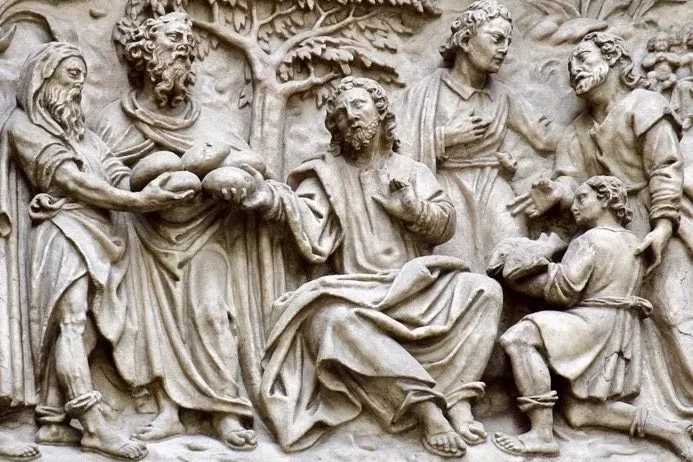
he Gospel account of the multiplication of the loaves begins with a terrible news. Jesus has just received the news of the death of John the Baptist. He seeks a little silence, a lonely place, perhaps a time to entrust His grief to the Father. Yet, just as He seeks solitude, the crowds find Him, turning that lonely place into a place of encounter.
The story begins precisely there, in the midst of a “crisis”. And this already speaks to our own lives, because we too know those “desert places”: moments when we feel empty, disappointed, inwardly exhausted. There are the “dark nights” of the soul (cfr. St John of the Cross), when it seems we have no strength left for anyone. Yet the Gospel shows that it is precisely there, where human beings encounter their limits, that God can open up a new horizon.
The crowds reach Jesus in the wilderness, and the Gospel says that He “had compassion for them”. The Greek verb splanchnizomai, used by Matthew, is remarkably powerful. It does not describe a simple and superficial feeling of pity but a movement from the very depths of one’s being, a stirring of the innermost heart (the “womb”). It is as though the suffering of others enters into Him. Jesus does not look down on the crowd, nor does He see them as an inconvenience to be avoided. He allows Himself to be touched. He sees men and women who are weary, wounded, confused, hungry not only for bread but also for hope, meaning, and someone who will care for them.
How often, instead, our own gaze becomes cold. We see the need, but we try to protect ourselves. We react like the disciples: “Send the crowds away”. After all, it is the most instinctive way of thinking: the problem is not ours; let everyone take care of themselves. It is the logic of the world. Even relationships can begin to reflect this mentality: I welcome you as long as you are not too demanding, as long as you do not ask too much, as long as you do not disturb my peace. But Jesus shatters this way of thinking with a disarming command: “You yourselves give them something to eat”. The Lord does not allow His disciples to remain mere spectators of another person’s hunger. He involves them. He makes them responsible.
Immediately the objection arises: “We have only five loaves and two fish”. This is the voice of our own inadequacy. Faced with the immense needs of the world—the hunger for love, for listening, for justice, for peace—we feel our poverty. We have little time, little patience, little strength, little faith. We think that what little we have is worthless. Yet again the miracle begins precisely there: when that little is placed into the hands of Jesus.
The Lord does not ask His disciples for what they do not have. He asks for what they do have. He does not create bread out of nothing; He begins with a gift that is fragile,
disproportionate, and not enough. But when the little that belongs to humanity is placed into God’s hands, something new happens. The bread is multiplied, the wilderness becomes a banquet, and shortage is transformed into abundance.
Perhaps the true miracle is not only the multiplication of the bread but also the conversion of the human heart. A closed hand creates hunger; an open hand creates communion. As long as we hold tightly to everything out of fear of losing it, nothing is ever enough. But when we share, we discover that God makes fruitful even what once seemed insignificant.
The Gospel takes on a profoundly Eucharistic meaning. Matthew uses the very same actions that will appear again at the Last Supper: Jesus took the bread, said the blessing, broke it, and gave it. The bread distributed in the wilderness already foreshadows Christ’s total gift of Himself. It is not merely food that satisfies bodily hunger; it is the Lord Himself who becomes nourishment for humanity.
Every Eucharist teaches us this same logic. Jesus takes our poverty, blesses it, breaks it, and transforms it into a gift. Then He places it back into our hands so that it may reach others. The disciples receive the bread from Jesus and distribute it to the crowd. They are not the source of the miracle, yet they are indispensable in ensuring that the gift reaches everyone.
The Church, too, is called to be like this: not the owner of the bread, but the servant of its distribution. And every Christian is called to become Christ’s open hand in the world: through a word that brings comfort, patient listening, an act of selfless generosity, a faithful presence beside those who are alone.
Perhaps this is the most difficult and the most beautiful movement of the heart: from the logic of holding on to the logic of breaking and sharing. And human beings discover their true fulfillment not when they accumulate for themselves, but when, like Christ, they learn to become a gift for others.
Prayer
Lord Jesus, in the face of the world’s hunger we discover how small and inadequate we are. Take, then, the little that we are. Break our selfishness, open our closed hands, and make us capable of sharing the bread of charity, of listening, and of hope. Amen.