



Fr Marco Lazzaron
his Sunday’s Gospel gives us the essence of Christian life, which is love. The theme on which Jesus is put to the test is what to do to inherit eternal life; in v. 28 it is said: “do this and you will live”; in v. 37: “go and do likewise”. What is it that we must “do”? One thing: love, because life is love.
Now, Jesus, faced with the captious question of his interlocutor, a wise scribe, responds with a counter question: “What is written in the law? What do you read?” And the scribe, quoting Dt 6:5, responds correctly: you must love God with all of yourself and your neighbor as yourself. This teacher of the Law has discovered that the beginning of everything is love, not a cold code of laws to be respected. We are created in the image of God and it is love that makes us similar to Him.
However, this scribe, wanting to justify himself, asked: “and who is my neighbor?” At the time of Jesus, it was a serious question and there were two schools of thought in particular: the rigorist school for whom the neighbor was only someone belonging to one’s own clan or tribe. And then there was the more permissive school who saw in the neighbor also the foreigner who resided in Israel. Jesus further broadens the horizons and proposes as a model a Samaritan, considered by the Jews to be a heretic, a lost person, someone with whom one should not have anything to do. Basically, Jesus overturns the concept of neighbor: the problem is not who is my neighbor (any person without distinction can be one) but rather: to whom do you make yourself neighbor!
As Kierkegaard wrote: “Christ does not speak of knowing our neighbor but of becoming our neighbor: the Samaritan did not prove that the unfortunate man was his neighbor, but that he was the neighbor of the unfortunate man”. Our neighbor is someone that concerns me; it is not a definition, but an action; it is not a quality but a responsibility; it is not a category but a face, a concrete person. Cardinal Carlo Maria Martini similarly wrote: “Our neighbor does not already exist. We become neighbors. Our neighbor is not someone who already has blood, racial, business, or psychological affinity with me. I myself become neighbor in the act in which, in front of a man, even in front of a stranger and an enemy, I decide to take a step that brings me closer”. Therefore, Saint Augustine wrote: “Do not ask yourself: who is my neighbor? It is up to you to become a neighbor to those in need”.
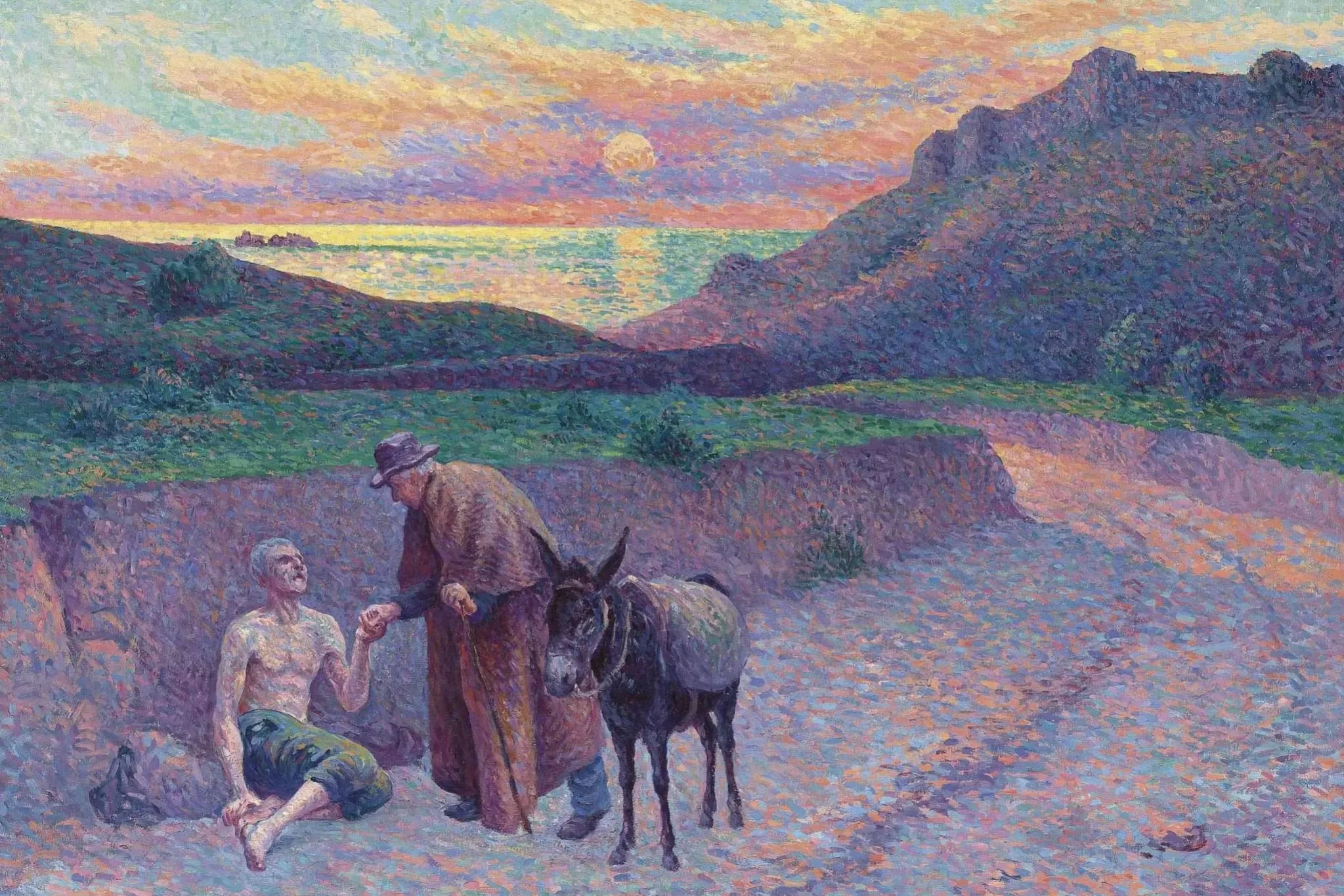
How to become a neighbour? In response, the Gospel gives us a series of verbs that punctuate the actions of the Samaritan: Passing by, seeing, having compassion, stopping, getting close, bandaging, carrying, taking care of, giving. Verbs that speak of a beating heart, of eyes that see suffering, of steps that come closer and do not go straight on, of hands that heal, that caress, that spend. May the Lord help us to embody this example, “to go and do the same”,
Prayer for the week:
“Lord, may I see and have compassion, as You see me and have compassion on me” (Pope Francis, 10th July 2022).