



Fr Marco Lazzaron
e are in the second Sunday of Easter, or Divine Mercy Sunday; a precious opportunity to rediscover, contemplate, and taste the infinite mercy of God.
Today, we find the disciples locked in a house. Not for prudence, but out of fear; fear of the Jews, fear of suffering, fear of death. The closed doors of the Gospel are not only made of wood: they represent the doors and the walls we build around us. Many times, out of fear of suffering again, we close ourselves off from love.
But here, precisely in this closure, the risen Lord makes His presence known. First of all, He doesn’t knock, He doesn’t ask questions. He stands in the midst of them and says, “Peace be with you”. Jesus’ peace is not just a wish, it is a gift: it is the gift of that true peace from which Jesus is the source. A peace that is not the absence of problems, but the presence of Someone who makes you feel safe even within those problems. It is the gift of peace from Someone who loves you and forgives you even before you realize it. It is to those disciples and to us, closed in our fears, in a feeling of guilt and inadequacy, that Jesus comes and says: “Peace”.
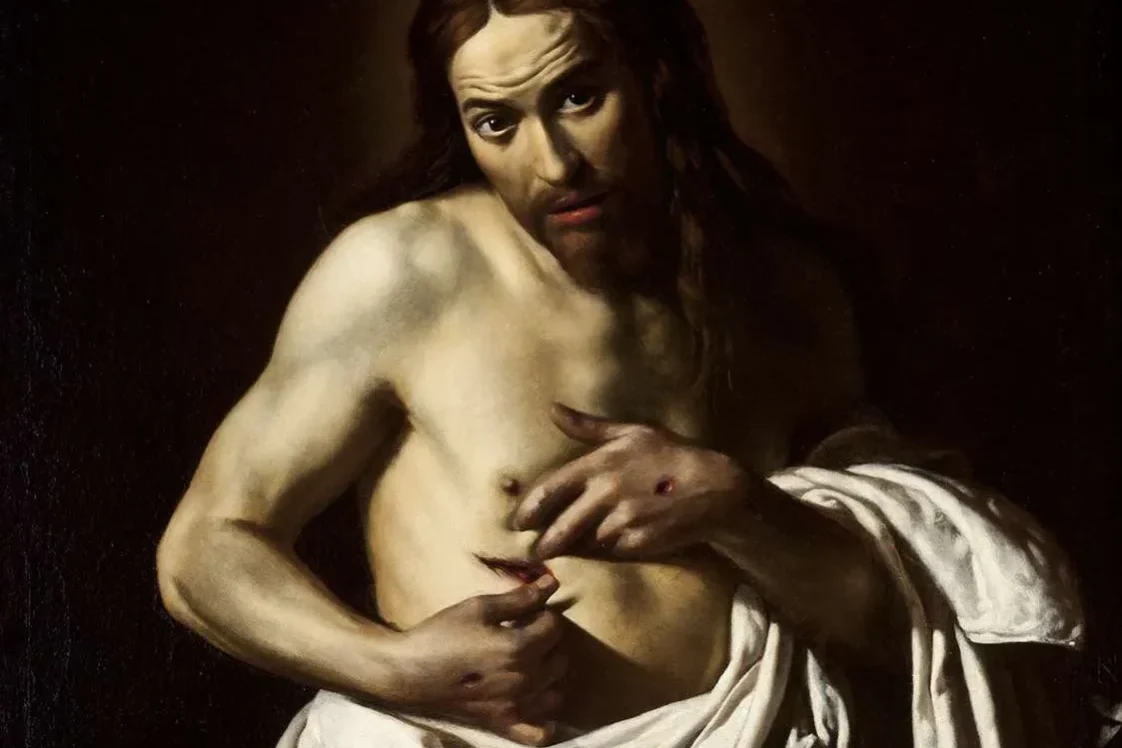
Then Jesus shows them His wounds. He did not want to erase them; the wounds remain, but they no longer hurt as they did before. They are like seals of authenticity: it is truly He, the risen One, who has loved us in this way, to this extent. In those wounds, now folds of life, lies the price of our redemption. Jesus is not ashamed of His wounds, for they are the place where love has triumphed.
Immediately after, Jesus breathes on them. It is a fragile, human, almost intimate gesture. It’s like saying, “Let’s begin again from here”. The Holy Spirit does not come like a spectacular fire, but like a breath that lifts up those who were out of breath, like a breath capable of giving life back to those who were already extinguished. The Church is born this way: not from heroes, but from frightened men who receive an undeserved trust and, with it, a life capable of overcoming every closure, every sin, even death itself: the very life of God in them. The breath of life continues to reach us, especially through the sacrament of reconciliation, a moment of grace in which the Lord raises our souls to new life.
And then we have Thomas. He is not satisfied with the accounts of others; he wants to touch, he wants a real experience. But he is not completely closed off from the testimony of others. In fact, eight days later, the following Sunday, Thomas is with the gathered community. And Jesus returns specifically for him. God has infinite patience and does not want to lose anyone along the way. And when Thomas finds himself before the Risen One, he does not say, “Now I understand”, but: “My Lord and my God”. Faith is not understanding everything, but recognizing Who is before you. In the end, Jesus says: “Blessed are those who have not seen
and have believed”. Blessed are we, who do not see the Risen One with the eyes of the body but continue to trust and believe that it is worth following Jesus, that it is worth loving, forgiving, and trusting.
In the end, the experience of Easter is an experience of mercy. God comes to meet us in our closures, He remains with the wounds to give meaning to ours, and He is not afraid of our doubts. Finally, He sends us into the world not as perfect or resolved individuals, but as sons and daughters reconciled with our own fragility.
Prayer
“Jesus, You have just died, and already a spring of life has gushed forth for our souls. O spring of life, incomprehensible mercy of God, envelop the whole world and pour Yourself out upon us. O Blood and Water that flow from the Heart of Jesus, as a fount of mercy for us, I trust in You”. (St. Faustina Kowalska)