



Fr Marco Lazzaron
isten, Israel: The Lord our God is the one Lord. You shall love the Lord your God with all your heart, with all your soul, with all your strength (Dt 6:4-5).
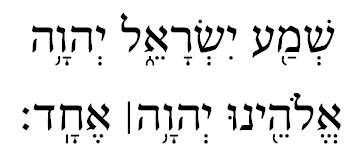
In the image above, you can read from right to left the original Hebrew for Dt 6:4 that is read: Shemà Israel, Adonai Elohenu, Adonai Ehad: Listen, Israel: The Lord is our God; the Lord is the only one.
What is the greatest commandment? This is the question that the Pharisees put in front of Jesus; they ask him an opinion, a technique used also by the devil to tempt Jesus in the desert. But Jesus answers all these temptations with the truth made flesh. With facts, not with an opinion. Jesus was the Shemà made flesh in all the miracles he was doing.
All his miracles were a witness of the love of God coming down on earth; he was the “commandment” offered freely for every person. The Pharisees could have just listened to him, and had life eternal or refused him and remain in their own sins. And we can do the same. Every day, we face these two ways before us and we need to choose which road to take.
Every day, for those who pray the Liturgy of the Hours, we read: If today, you listen to his voice, harden not your hearts. It is enough to listen to Jesus, recognizing that we are little, sinners, without defending ourselves so as to open wide the doors of our heart (as St John Paul II once said) and letting him in.
On the cross, Jesus fulfilled the Shemà for us: the “mind” as his head was crowned with a crown of thorns, the “strength”, as he was nailed to the cross hands and feet; the “heart” as his side was pierced by a lance.
All this is a gift for us, entrusted to the maternal care of the Church. Through the Sacraments, listening to the Word of God, and being in communion with our brethren, the Shemà can also be fulfilled in us so that we are able to do the will of God, offering up our lives, giving to God our mind, our strength and our heart. It is in the Christian community of the Church that the Shemà can be fulfilled. Even though, generally, a commandment can be seen only as a limitation, something we cannot do, or something we would rather not do because is not enjoyable, the commandment that Christ gives us is a new commandment, a way of restoring our life to the fullness.