


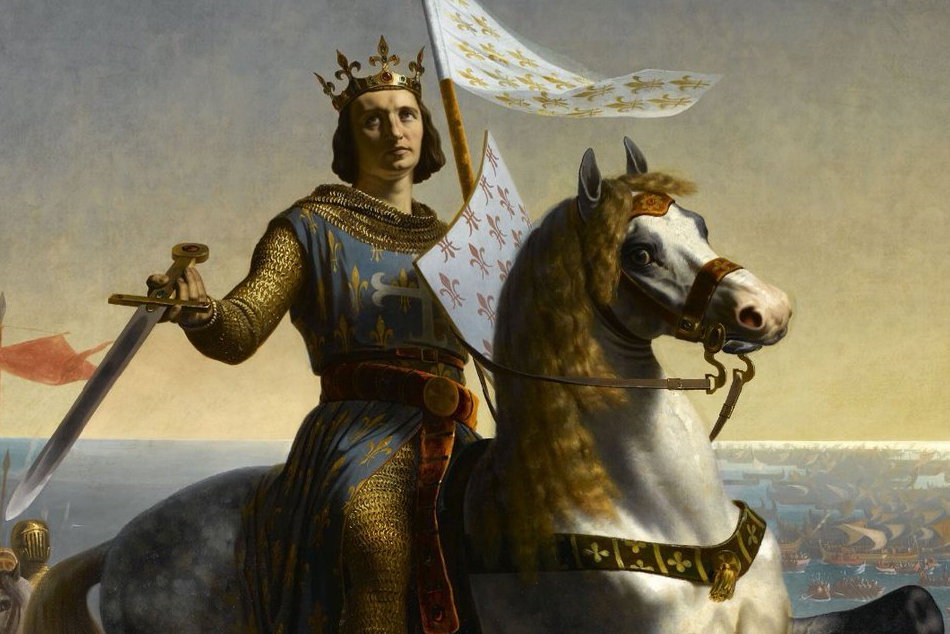
Feast Day: 25 August
Louis IX was born in Poissy, France in 1214 to Louis VIII and Blanche of Castille. He succeeded to the throne at the age of twelve under the regency of his mother. On his twenty-first birthday he assumed full kingship.
He was well known for protecting the French clergy from secular leaders and for strictly enforcing laws against blasphemy.
Louis united France — lords and townsfolk, peasants and priests and knights — by the force of his personality and holiness. For many years the nation was at peace.
Louis generally remained neutral in international disputes. However, because of a dispute between the Count of Le Marche and the Count of Poitiers, in which Henry III supported the Count of Le Marche, he was forced to go to war with England. In 1242 Louis defeated Henry III at Tailebourg. After the war, he made restitution to the innocent people whose property had been destroyed.
Louis was devoted to his people, founding hospitals, visiting the sick, and like his patron St Francis, caring even for people with leprosy. He is one of the patrons of the Secular Franciscan Order. Every day, Louis had 13 special guests from among the poor to eat with him, and a large number of poor were served meals near his palace. During Advent and Lent, all who presented themselves were given a meal, and Louis often served them in person. He kept lists of needy people, whom he regularly relieved, in every province of his dominion.
He established the Sorbonne (1252) and the monasteries of Rayaumont, Vavert, and Maubuisson. Louis led two crusades, the Sixth and the Seventh Crusades. He was captured and imprisoned during the Sixth (1244-1249). At the onset of the Seventh Crusade in 1270, Louis died of dysentry. Boniface VIII canonised him in 1297.