


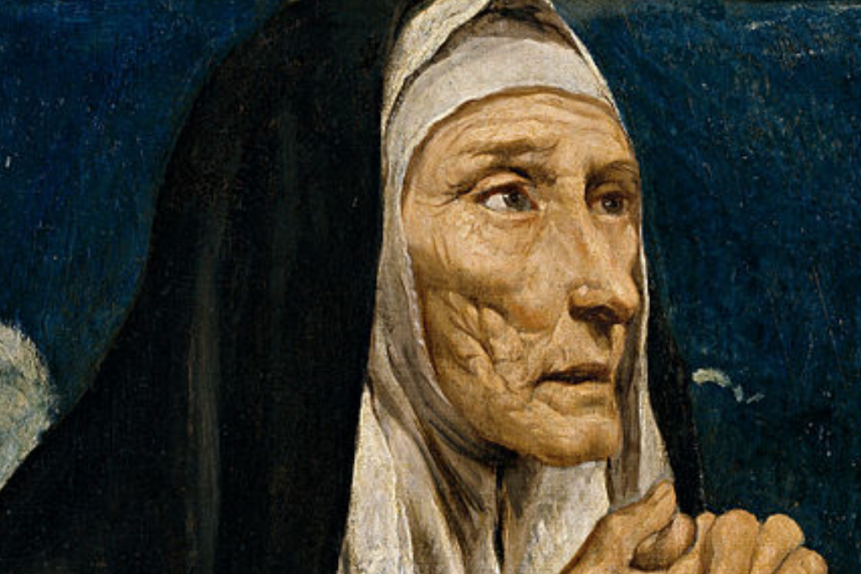
Feast Day: 27 August
If you’ve ever prayed really hard for a miracle and felt discouraged by the response (or lack of) that you received from your pleas, take your cue from St Monica. She is an inspirational woman who showed us that through love and prayers we can move mountains, or in her case, move members of her family to change for the better.
Monica (332-387) is the mother of St Augustine of Hippo. She was born into a Christian family in the town of Thagaste, now Souk Ahras, in Algeria. Her husband, Patricius, appears to have been religiously indifferent, but he did not interfere with Monica’s faith and permitted her to raise their children as Catholics.
When Augustine was born, Monica did not have him baptised. During the first centuries of the Church, many Christians put off baptism until they were on their deathbed. Nonetheless, Monica did have her priest mark the infant Augustine with holy oil in the sign of the cross and sprinkle blessed salt, a sign of exorcism, on his tongue. This ceremony would have made him a catechumen, one who was taking instruction in the faith, and Monica was Augustine’s teacher.
Monica and Patricius were ambitious for their son. They wanted Augustine to receive a classical education so he could enter one of the professions. Before Augustine went off to the university at Carthage — the Oxbridge of Roman North Africa — Monica pleaded with him to remain chaste. In his “Confessions,” Augustine admits he treated her “womanish advice” with contempt. He was, as he says, “in the mood to be seduced”; in fact, soon after he arrived in Carthage he found a mistress, and they moved in together. A year later, the woman (in none of his writings does Augustine ever mention her name) gave birth to a baby boy whom they named Adeodatus, meaning “gift from God.”
Augustine also abandoned the Catholic faith and joined the Manicheans, a sect that considered itself an intellectual and spiritual elite. Manicheans taught that there were two gods — one good, the other evil — who were in constant conflict for control of the universe. Throughout history many “Jesuses” had come to earth to struggle on the side of good, but none had ever triumphed over evil.
To have her son join such a sect broke Monica’s heart. She sought out a bishop who once had been a Manichean and begged him to go speak to Augustine. The bishop answered that so early in his conversion Augustine would not be willing to listen to any arguments against Manichaeism. But Monica would not take no for an answer. She pleaded and wept and made such a nuisance of herself that the bishop lost his temper. “Go away from me!” he cried. Instantly regretting his bad manners, he added, “Do not worry. It is not possible that the son of so many tears should be lost forever.”
Seventeen years passed before Augustine was ready to re-evaluate his life. By that point, he was teaching philosophy in Milan. Monica had moved there, too. In Milan, she found an ally in the city’s bishop, St Ambrose. Augustine began attending any Mass where Ambrose was scheduled to preach. Between Monica’s prayers and Ambrose’s eloquence, Augustine renounced the Manicheans and entered the Catholic Church. On the night of 24 April 387, at the Mass of the Easter Vigil, St Ambrose baptised Augustine and Adeodatus. The prediction an irritable African bishop had made to Monica so many years before had been fulfilled at last.
St Monica is also the patron of homemakers, married women and victims of abuse by their spouses.
1 Comment