


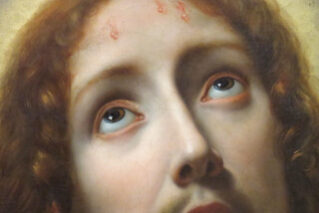
When he is told that “some Greeks”, who have come to Jerusalem for the festival of Passover, want to see him, Jesus tells his disciples that “the hour” for him to be glorified has arrived. The period of his revealing his glory, which began with the first sign at Cana and ended with the final one of the raising of Lazarus, is over, and his passion is about to begin.
One of the features of the Fourth Gospel (John) is that some of the most dramatic scenes which we encounter in the three Synoptic Gospels are missing: these include the testing of Jesus in the wilderness (the temptations) and the agony in the garden (better expressed as the struggle in Gethsemane). However, we find the components of these episodes scattered in the Johannine account. The scenes mentioned present Jesus struggling with what it means to be the Son of God and to be faithful to his mission. They show Jesus in a very human light: in our Gospel reading today, Jesus realises that his hour, the complex events of his passion and exaltation on the cross, has arrived and the possibility of praying to be spared it comes to his mind. However, he overcomes this understandable reaction and accepts the Father’s will, since this is the purpose of his coming. The voice from heaven then vindicates Jesus’ choice. There is a tendency sometimes to play down the human aspect of Jesus, to eliminate any hesitation or struggle on his part: although the Fourth Gospel views the crucifixion as the lifting up of Jesus in glory, this passage reminds us of the enduring dark nature of the cross.
REFLECT
It is difficult to keep in balance the two natures of Jesus, the divine and human aspects of his being. The Gospel traditions about his being tested and his final test before the passion, described by the Synoptics in the Gethsemane scene and hinted at in our Gospel reading today from John, suggest that we should not forget or play down Jesus’ human nature. The Gospel of John shows Jesus as being well aware of his divine nature and relationship with the Father, but the temptation to take shortcuts to fulfil his destiny as the Messiah or to avoid the supreme test of the passion altogether is still there, albeit in a much more subtle, but no less real, form.
If it is true, as the letter to the Hebrews tells us, that Jesus “has been put to the test in exactly the same way as ourselves, apart from sin”, then we should not be afraid to imagine Jesus as being moved in much the same way as we would be in his shoes: for example, the Fourth Gospel tells us that Jesus is “troubled” when confronted with death. If Jesus is to be our model, then we need to know that he understands our human condition from his own experience and can sympathise with us in our difficulties and fears.
LEARN
The Gospel of John does not contain some dramatic scenes which we find in the Synoptic Gospels:
These include the temptations of Jesus, the agony in the garden, and the trial before the Sanhedrin. The agony in the garden is more accurately understood as the struggle in Gethsemane of Jesus to remain faithful to the ultimate act of obedience to his mission from the Father.
DO
Take the crucifix in your hands; reflect on the figure on the cross and o the human nature of Jesus.
SAY
Christ offered up prayer and entreaty, aloud and in silent tears. (Hebrews 5:7)