


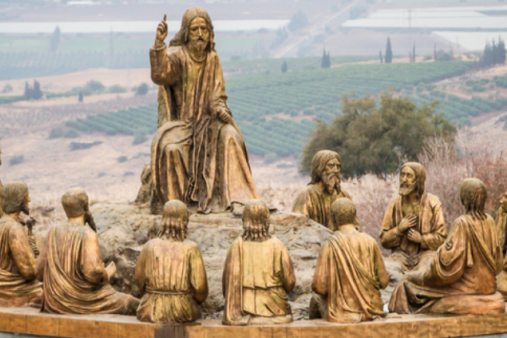
Not long before the episode which we heard about in our Gospel reading today, Jesus had sent out the Twelve on a mission of preaching the kingdom, accompanied and illustrated by works of healing and exorcism.
Now, Jesus sends out a larger group with a similar commission and they come back to report that their mission has been successful. We might note that, for Luke, the Twelve are essentially disciples of Jesus among a wider group. They have been specially chosen from this larger number, among whom Luke specifically mentions women by name. Thus, the sending of the seventy-two mirrors the sending of the Twelve.
The twelve apostles represent symbolically the twelve tribes of Israel. They are, in the Gospel tradition, essentially witnesses to the risen Jesus, but are eclipsed very shortly by the deacons and then by the apostle Paul, who had not known Jesus during Jesus’ earthly life. Luke shows that Jesus includes the wider group of disciples in his mission: it is not restricted to Peter and the other members of the Twelve.
Jesus tells the disciples that if the citizens of a town refuse them hospitality, a sacred duty in the culture of the time and place, “it will not go as hard with Sodom as with that town”. The sin of Sodom to which Jesus refers was the breach of the law of hospitality, which is the reason why the disciples should leave, shaking off the very dust of the place as a sign to those who failed to live up to their obligations to the stranger and traveller.
Previous Sunday Messages


REFLECT
It is worth keeping in mind that in Luke’s account of Jesus and his ministry, Jesus is consistently accompanied by a wider group of disciples than simply the Twelve, including women whom Luke, unusually, mentions by name. These disciples, “the whole crowd”, were with Jesus at his entry into Jerusalem, when he went to Gethsemane, so it does not make sense to say that they disappeared at the celebration of the Passover, which was essentially a domestic and family occasion. The larger group was also present at Pentecost, along with Mary, the mother of Jesus.
A picture is worth a thousand words, as they saying goes. Sometimes, this can be very telling and capture the spirit of the scene, as when the magi are presented with different racial features and characteristics. But it can also limit our imagination and influence our understanding of the biblical text. So, were the disciples Jesus sent out only male persons? Were only Jesus and the twelve male apostles present at the Last Supper? Is our understanding of that event influenced by Leonardo da Vinci’s famous fresco or by Luke’s Gospel narrative? Where were the other male disciples, the women – and, therefore, presumably, the children?
When Luke talks about “disciples”, he does not mean simply “the twelve apostles”. When we listen to the Gospel, we might keep this wider meaning in mind – and include ourselves among the disciples.
learn
- Luke consistently shows Jesus accompanied by a wider group of disciples than just the twelve male apostles.
- Among this larger group were women.
- The sin of Sodom was essentially a breach of the law of hospitality, which enjoined the hosts to protect and shelter the traveller and stranger.
do
Extend the sign of peace to your neighbour: remember that we are all disciples of Jesus, sharing in his mission.