


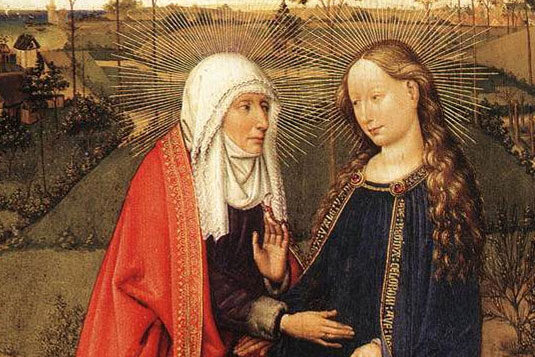
The first two chapters of the Gospel of Luke are a highly artistically constructed series of five scenes (this excludes the later one of the finding of the child Jesus in the Temple) and the central event is the meeting of Mary and Elizabeth, both pregnant, with Jesus and John the Baptist respectively.
The reason for Mary’s visit to her cousin is not, as often supposed, out of concern for her welfare or an act of kindness or charity, but rather is part of the stereotyped account of the annunciation of the birth of a significant person in the divine plan. The final and sixth element in the narrative is the giving of a sign. In this context, the sign is the confirmation of the divine or angelic word: it is an assurance that the person receiving the message has not dreamed or imagined it. Thus, Elizabeth’s being pregnant is the sign to Mary that Gabriel’s communication was genuine. Mary’s visit is to confirm that she has understood correctly her experience with God’s messenger. This is the only scene in which the two mothers meet: the unborn John the Baptist gives testimony to the arrival of the child Jesus, just as later he will proclaim the coming of the Messiah. Elizabeth hails the arrival of “the mother of my Lord” and her words have passed into the Christian tradition as part of the most common and popular prayer to Mary.
Previous Sunday Messages


REFLECT
The scene of the visitation is the central occasion of Luke’s Infancy Narrative, the first two chapters of his Gospel. It brings together the two mothers, Elizabeth and Mary, and their unborn children, John and Jesus. After this, they diverge and we are given the accounts of the birth of the two children. Always, Luke presents Jesus as superior to the Baptist. Elizabeth is cast in the mould of the mothers of important figures in Jewish tradition who are unable, for some unspecified reason, to conceive naturally, but by divine intervention are able eventually to give birth. Mary’s virginal conception is of a different order: this to insist that Jesus is the Son of God and has no human father.
It is important to remember that the Gospels are theological documents: they are expressions of faith. While we might be inclined to see events such as the visitation in terms of human sympathy, there is much more at work, much more depth to figures such as Elizabeth and Mary than a surface reading of the text might suggest.
It is worth reflecting on Elizabeth’s final words to Mary: “Blessed is she who believed that the promise made her by the Lord would be fulfilled.” In the Bible, the verb “to believe” can be understood as “to trust”. Perhaps if we thought more about trusting God rather than simply believing in God, we might be closer to the attitude of Mary and Elizabeth and to that of Joseph and Zechariah. Luke is always emphasising the need to listen to the word.
learn
- The point of Mary’s visit to Elizabeth is to confirm Gabriel’s message at the annunciation.
- In biblical annunciation narratives, a sign is always given to assure the recipient that they have not imagined or dreamed their experience.
- People who demand signs as proof are condemned: this is not the same as individuals, such as Mary, checking out signs that they have been given by the divine messenger.
do
Set out the figure of the shepherd from your crib set: reflect during the week on how seemingly ordinary people received news of the birth of the Messiah rather than official and educated individuals.