


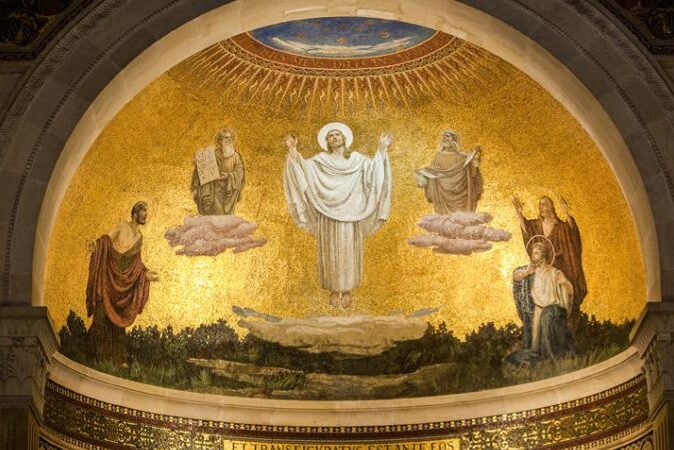
The episode in today’s Gospel, which we usually call the transfiguration of Jesus, marks, in dramatic form, the turning point in Jesus’ ministry.
Up to this point, he has been preaching and healing in Galilee: now he begins his journey towards Jerusalem and his destiny. The vision of Jesus in glory, which is granted to his closest male disciples – Peter, James and John – gives them, and ourselves, a glimpse of Jesus’ deepest being. We recognise the similarities between this incident and that of Jesus’ baptism: the cloud represents the divine presence and the voice of God, which declares Jesus as God’s Son, the Chosen One. Just as Jesus’ baptism stands at the beginning of his ministry in Galilee, so the vision of Jesus in glory marks the start of his journey towards Jerusalem, his ministry in Judea and the holy city, which leads to his Passion and death on Calvary.
Luke makes connections with the Jewish traditions found in the Hebrew scriptures. The two figures who appear in glory, in conversation with Jesus, are Moses and Elijah. Moses received the Law from God on Mount Sinai and facilitated the Covenant between the Lord and the people of Israel. Elijah represents the prophetic movement within the story of Israel, which challenges the legal system and reminds the clergy and laity of the deeper meaning of the Law: that its purpose is to bring the person and nation into an intimate, personal relationship with, and commitment to, the Lord.
It is this vision, in both senses, which is given to us as we continue our Lenten journey towards Easter.
Previous Sunday Messages


REFLECT
Once in a while, we may have a sense of how life can really be, of the person we would like to be ideally. The story in today’s Gospel is something like that: Peter wants to prolong the experience of seeing Jesus in glory, so he proposes constructing shelters for Jesus, Moses and Elijah. Luke observes, perhaps wryly, and maybe affectionately, that “He did not know what he was saying.”
Peter is the impulsive character, always speaking before thinking. But perhaps he is more honest than many others: he is not calculating and always getting into trouble. When we read or listen to the Gospels, we are invited to ask ourselves, with whom do I identify? With what character am I most in sympathy? There is no right or wrong answer; we are being invited to enter into the Gospel story and to make it part of ourselves.
Moses and Elijah are talking with Jesus about “his passing which he was to accomplish in Jerusalem”. Jesus is about to embark on the journey which will lead him to his destiny. None of us know where life will lead us, or what life has in store for us. Our observance of Lent, however we decide to keep it, is intended to help us reflect more deeply on our relationship with the Lord. Peter wanted to take a shortcut; he was quickly disabused of this notion.
learn
- The transfiguration of Jesus is the mirror image of the story of his baptism.
- Both reveal to the readers of the Gospel Jesus’ true identity as the Son of God.
- The baptism stands at the beginning of Jesus’ ministry in Galilee.
- The transfiguration heralds the start of Jesus’ journey to Judea and Jerusalem.
do
Make the sign of the cross: reflect on how this represents Jesus’ passing which he was to accomplish in Jerusalem.